

Solar Power Battery Suppliers: How Voltsmile Redefines B2B Energy Storage Partnerships in 2026
The global solar storage battery market will reach $20.98 billion by 2032. This growth creates a crowded supplier landscape. Procurement managers must now distinguish assemblers from true manufacturers. For B2B buyers and installers evaluating solar power battery suppliers, price alone no longer decides partnerships. Instead, vertical integration, LFP expertise, and long-term viability matter more.
Voltsmile combines German engineering standards with scalable manufacturing efficiency. Consequently, this article examines what separates leading solar battery suppliers. Moreover, it explains why Voltsmile’s integrated model delivers concrete B2B advantages.

The LFP Imperative: Why Chemistry Determines Supplier Credibility
Lithium Iron Phosphate (LiFePO4) now dominates stationary solar storage. Unlike NMC batteries, LFP offers superior thermal stability and resists combustion. Therefore, it eliminates thermal runaway risks in most installations. LFP cells typically deliver 3,000–6,000+ cycles at 80% depth of discharge. By contrast, NMC alternatives manage only 1,000–2,000 cycles.
Voltsmile’s LFP cells exceed these benchmarks, reaching 6,000–8,000 cycles. For daily cycling systems, this translates into over 15 years of performance. Meanwhile, LFP’s cost per cycle ranges from $0.05–$0.08. NMC, however, costs $0.12–$0.25 per cycle. Consequently, this differential dramatically lowers the Levelized Cost of Storage.
A reliable solar power battery supplier must master LFP chemistry. Simply assembling third-party cells will not suffice. Voltsmile controls cell selection, BMS design, and thermal management in-house. As a result, chemistry advantages become real-world reliability.
Vertical Integration: The Supply Chain Advantage B2B Buyers Cannot Ignore
The solar battery supply chain remains concentrated in Asia. Vertically integrated Chinese facilities handle everything from cell fabrication to final assembly. However, integration depth varies dramatically between suppliers. Many companies operate as value-added assemblers. Specifically, they purchase cells and BMS components externally. This model introduces quality variability and fragile supply chains.
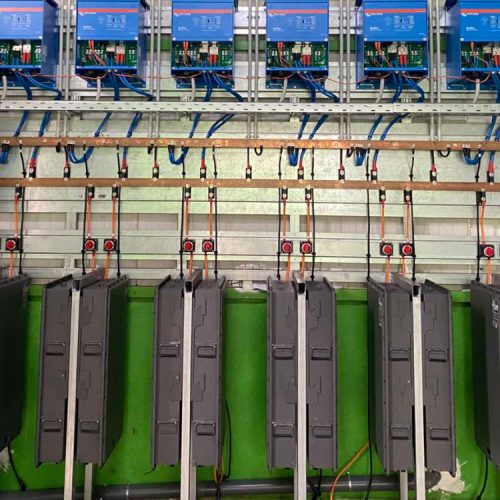
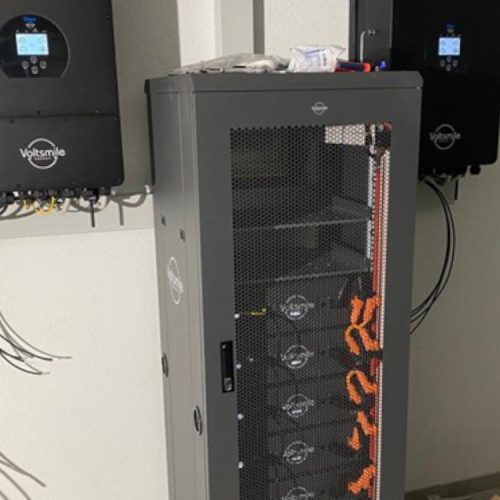
Voltsmile operates differently. As a vertically integrated manufacturer, the company manages cell selection, BMS design, and final assembly internally. This approach yields three critical advantages for B2B partners.
First, in-house control eliminates the weakest-link problem. Mismatched components create failure points in assembled systems. Voltsmile’s factory achieves a defect rate of just 0.02%. The industry average, meanwhile, sits near 1%.
Second, firmware iteration accelerates. When BMS and battery development happen together, updates and optimizations arrive faster.
Third, partners gain a unified warranty. Multiple vendors often create liability confusion during system failures. In contrast, Voltsmile provides one warranty covering the complete system.
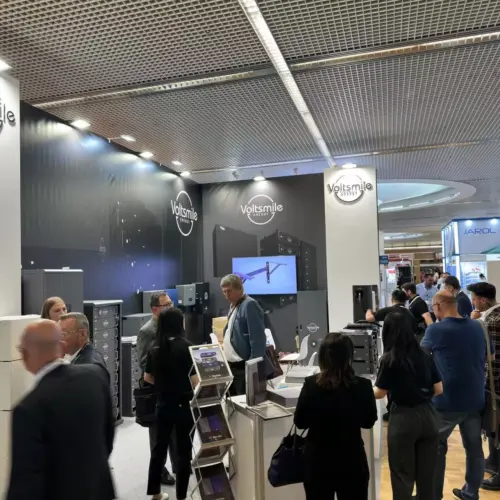
Voltsmile maintains headquarters in Shenzhen. Strategic production facilities span Huizhou, Jiangxi, and Dongguan. Additionally, market centers operate in Amsterdam and Düsseldorf. This global footprint ensures supply chain resilience across Europe, North America, and Asia-Pacific.
Beyond the BMS: Intelligent Management and Inverter Compatibility
A battery’s reliability depends fundamentally on its management system. Voltsmile integrates a proprietary multi-layer Battery Management System. This system monitors voltage, current, and temperature in real-time. Furthermore, active cell balancing keeps every cell at peak efficiency. Consequently, it prevents the “weakest link” syndrome affecting battery banks.
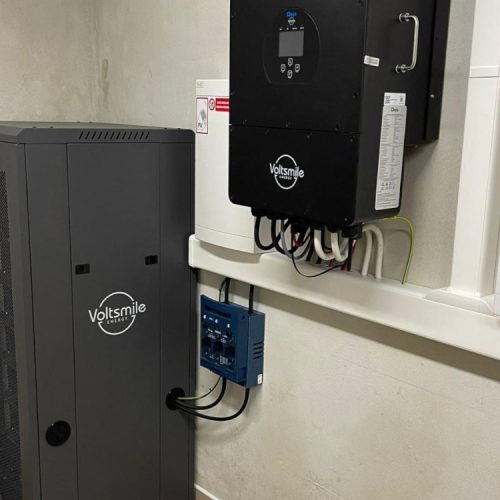
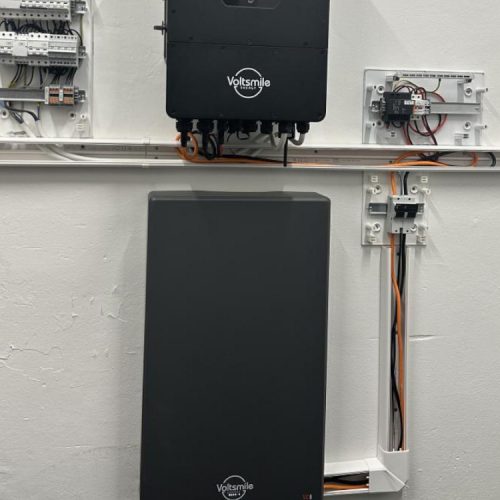
Communication compatibility proves equally vital for system integrators. Solar batteries must integrate seamlessly with hybrid inverters. These include Victron, SMA, Growatt, and Deye models. Therefore, Voltsmile’s BMS supports CAN bus, RS485, and Modbus protocols. This enables plug-and-play functionality, reducing installation time. Moreover, it eliminates compatibility headaches.
In an increasingly competitive market, B2B buyers should evaluate solar power battery suppliers carefully. Look beyond cell specifications. Instead, assess the intelligence embedded in the management layer. Also examine inverter compatibility breadth.
OEM/ODM Capabilities: The Strategic Differentiator
Generic batteries offer no competitive advantage to energy brands. Conversely, OEM and ODM capabilities enable partners to build proprietary product lines. These reflect brand identity and address specific market segments.
Voltsmile offers comprehensive OEM/ODM services. These encompass capacity and voltage customization from 5kWh to 50kWh+. Options also include battery chemistry and smart energy management integration. Clients can apply their branding, packaging, and software interfaces. Consequently, they ensure seamless market entry.
The customization extends to technical specifications. BMS parameters and communication protocols adapt to specific inverters. This creates proprietary assets for partners. Whether serving residential installers or commercial projects, Voltsmile’s manufacturing flexibility accommodates diverse requirements. For example, 48V low-voltage systems and 800V high-voltage stacks both remain achievable.
Certifications: The Non-Negotiable Baseline
Lithium batteries face rigorous global regulations that vary by region. Therefore, reputable solar power battery suppliers must hold essential certifications. These ensure market access and safe transportation. Voltsmile’s products comply with UL 1973 and IEC 62619. They also meet UN38.3, CE, and RoHS/REACH standards.
For B2B buyers, selecting a certified supplier eliminates months of administrative work. Consequently, it accelerates time-to-market. Custom models reach deployment faster when the underlying platform already meets regulatory requirements.
The 2026 Market Context: Why Supplier Selection Matters More Than Ever
The residential energy storage market is shifting fundamentally. Price competition is giving way to value competition. From 2023 to 2025, system prices declined over 55%. Low-cost assemblers using consumer-grade cells drove this decline. However, the consequences of this race to the bottom are now visible. Installers across Europe and Australia report severe battery degradation. Specifically, batteries degrade to 70% capacity within two to three years. As a result, after-sales costs exceed original profit margins.
The market response has been decisive. Installers now prioritize cycle life and degradation curves. They also weigh warranty terms and remote diagnostics over upfront cost. Leading brands have responded by extending warranties to 10 years. Automotive-grade LFP cells rated for 6,000 cycles back these warranties.
For procurement managers, this shift validates careful partner selection. Suppliers without vertical integration and LFP expertise cannot credibly offer extended warranties. Otherwise, they expose themselves to unsustainable warranty risk.
Conclusion: Choosing a Partner, Not Just a Supplier
The solar power battery suppliers landscape will continue consolidating. Market maturation separates genuine manufacturers from assemblers. For B2B buyers, the evaluation framework must extend beyond price sheets. It should encompass vertical integration and LFP chemistry credentials. BMS sophistication, certification completeness, and OEM/ODM flexibility also matter.
Voltsmile’s vertically integrated model addresses each dimension. By controlling the production chain from cell selection to final assembly, the company delivers quality consistency and warranty clarity. Furthermore, it provides customization capabilities that assembler-based suppliers cannot match. In a market where after-sales costs erode profit margins overnight, partner selection becomes critical. Choosing a manufacturer committed to cycle life and safety is not merely prudent. It is essential for sustainable growth.