


Comparing Battery Shipment Quotes: Supply, Freight and Destination Charges
Two offers for the same number of batteries may cover very different deliveries. One may stop at a collection point; another may include freight to a named destination but leave arrival charges unresolved. A lower headline price is not necessarily a lower cost for the same scope.
Before comparing totals, establish the exact goods, delivery basis, named place and responsibilities in each written offer. This is especially useful for distributors or installers buying batteries across borders.
Make sure the goods are comparable
Identify the battery model and supplied version, quantity, included accessories and packaging arrangement. Keep batteries, optional communication cables, mounting items and other equipment as separate lines where their inclusion differs.
A price for a battery module should not be compared with a price for a complete reviewed system without showing the difference. Likewise, an offer that excludes installation is not equivalent to one that includes local commissioning.
For a wall-mounted order, use the exact W1 product reference and request the offered revision, packaging and handling information. If another product is proposed, replace that reference with the actual model in the quotation. A product page is a starting point; it does not establish included accessories or freight services.
Put every offer on the same delivery basis
Ask each seller to state the delivery term, its edition and the precise named place. Descriptions such as “shipping included” or “to Europe” leave important details unanswered.
The International Chamber of Commerce’s Incoterms guidance explains how the rules allocate delivery responsibilities. DDP includes the seller’s responsibility for import clearance, while DAP leaves import clearance to the buyer. Those labels should not be used as interchangeable descriptions of a delivery to the same address.
Do not infer a seller’s ability to offer a particular term from a product advertisement. Ask the seller and freight provider to confirm the arrangement for the actual goods and destination. Where an offer is unclear, request a revised written scope rather than filling the gap with an assumption.
Separate the cost components
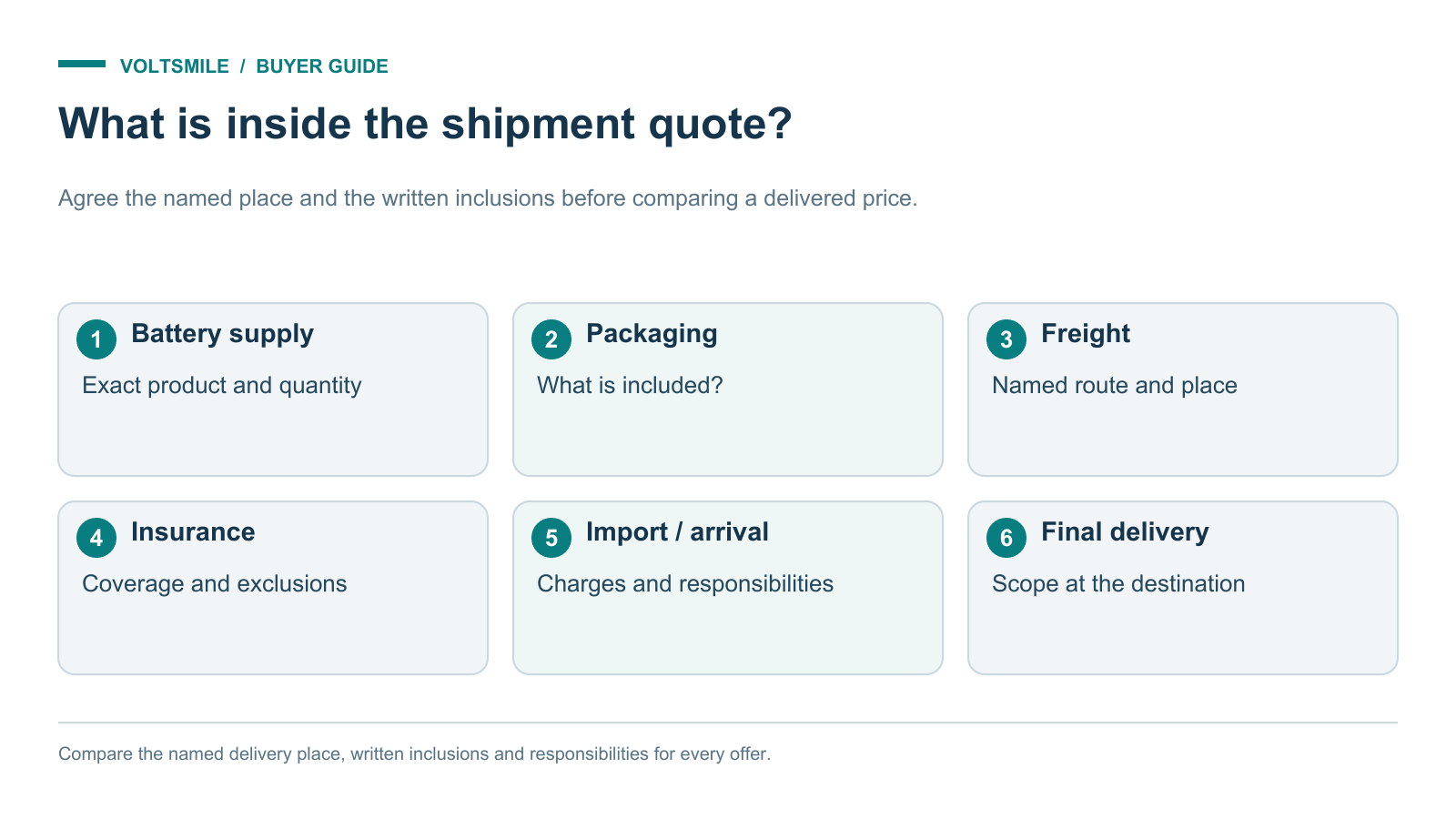
Compare battery supply, packaging, freight, insurance, export handling, import or arrival charges, and final delivery. Mark each item as included, excluded or awaiting confirmation. Do not count a charge twice simply because it appears in both a freight estimate and a supplier total.
Also ask about currency, quotation validity, quantity basis and any conditions that could change the amount. If several models or quantities are being discussed, keep each quotation revision with its own scope.
For the destination, clarify the actual receiving point and any relevant access or unloading arrangements. A delivery to a commercial receiving facility and a delivery to a residential address may involve different practical requirements. Let the service provider identify the implications instead of assuming the same last-mile arrangement.
Keep the shipment review separate from the price
A freight price does not establish that every battery or proposed route has been accepted for transport. Ask who will check the applicable battery documents, packaging, shipment description and carrier requirements.
If the route or transport mode changes, ask whether the review and price still apply. A quotation based on one set of goods and assumptions should not silently carry over to another shipment.
Do not treat an unverified document filename or a general claim of certification as a route approval. The relevant supplier and freight professionals need to review the exact consignment.
Define what happens outside the transport scope
Delivery is not the same as installation readiness. Identify who will receive and inspect the goods, how discrepancies will be reported, and which party provides installation and commissioning. Keep product warranty and transport-damage responsibilities in their applicable written terms.
A buyer should also know which contact will answer a technical mismatch and which contact will handle a shipment issue. Clarifying those roles before payment is more useful than discovering after arrival that each party assumed the other was responsible.
Request a comparable written response
Send the same product list, quantities, delivery point and requested scope to each supplier. Ask for clear inclusions, exclusions and open conditions. Compare the responses only after material differences are visible.
The project RFQ checklist helps assemble the wider technical enquiry. To request a Voltsmile discussion, provide the destination, exact model, quantity and the delivery basis you want assessed. Availability, route, charges and responsibilities should be confirmed in the actual offer.
If a rack-based layout is proposed, have its mechanical fit and service access reviewed before committing to the receiving site. That assessment concerns physical fit, rather than freight prices.
Questions buyers often ask
Does “door-to-door” necessarily mean all destination charges are included?
No. Ask for the agreed delivery term, named point and written inclusions. A descriptive phrase is not enough to compare two offers.
Can I compare prices before the final battery version is known?
Only as preliminary estimates with their assumptions visible. A firm comparison needs the goods and scope to be aligned.
Does an accepted shipping price confirm product installation suitability?
No. Shipment arrangements and the technical installation review are separate responsibilities.