


Comparing 51.2V Battery Datasheets Without Mixing Ratings and Conditions
Two battery datasheets can show the same nominal energy and still describe products with different operating limits, installation requirements and document coverage. A useful comparison begins by checking that the figures mean the same thing.
For an installer or distributor, the objective is to identify a suitable supplied version and the evidence needed for a quotation. A table of the largest numbers is not enough to establish that one battery can replace another.
Match the document to the offered product
Record the complete model, hardware or product revision where specified, document title and revision. Ask the supplier to confirm that these documents apply to the units being quoted.
Keep similar names as separate entries until their relationship is established. A rack-mounted product, a revised RPC version and a product with a “+” suffix should not be merged just because their headline capacity appears similar. Likewise, a file described as a family catalogue may not define the limits of every configuration within that family.
Start from the V10 RPC product and document route when discussing that model. Keep any alternative offer in its own column with its own documents.
Compare definitions before numbers
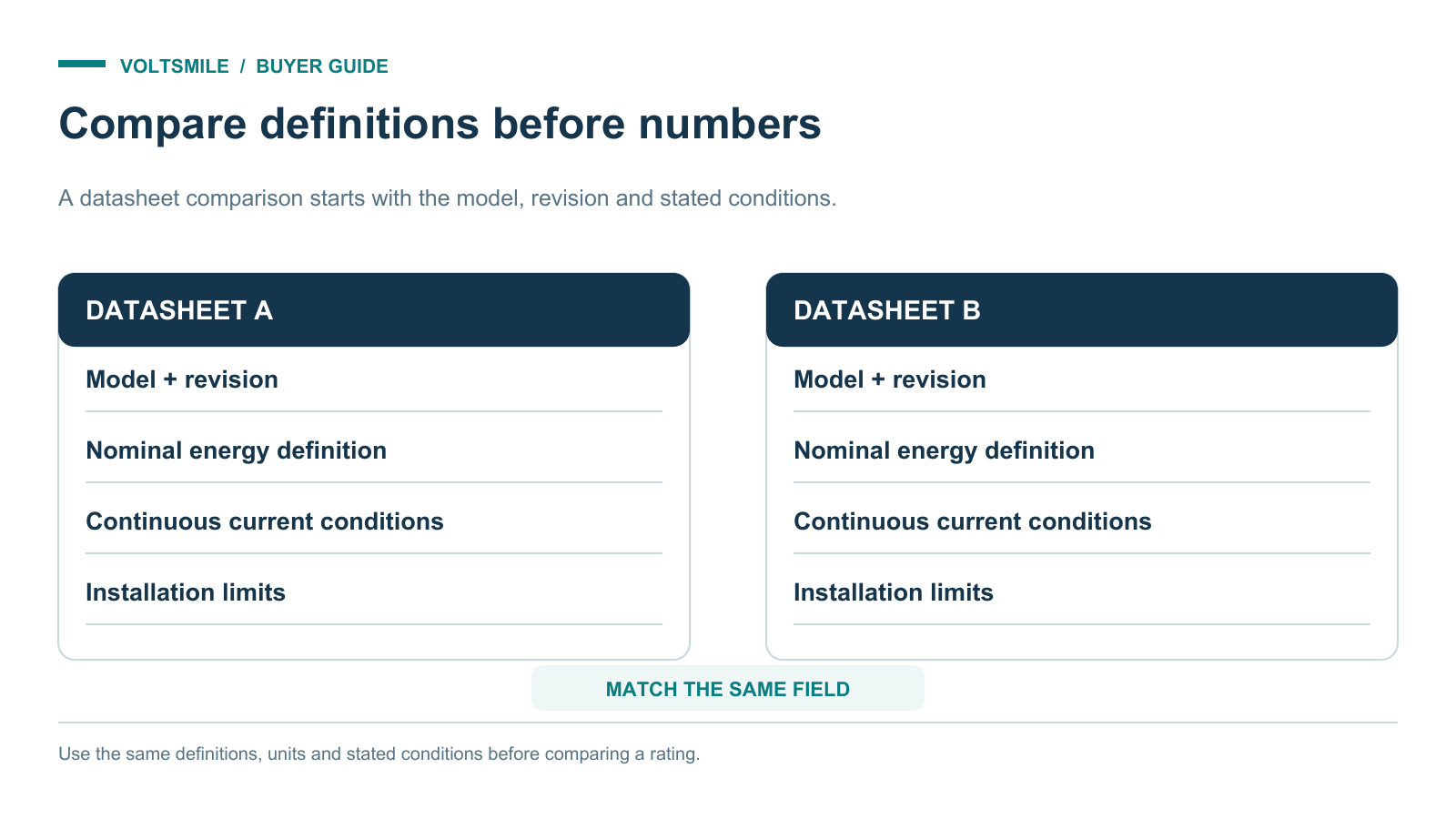
Nominal voltage multiplied by rated ampere-hours gives nominal DC energy. For example, the V10 RPC manual lists 51.2V and 100Ah; these correspond arithmetically to 5.12kWh nominal DC energy. That is not a promise of 5.12kWh usable AC energy at the household loads.
Separate nominal energy, usable battery energy and any stated system-delivered energy. If usable energy is quoted, ask for the operating window and other conditions used. Do not compare one supplier’s nominal figure directly with another supplier’s usable figure and conclude that the larger number represents a better system.
У "The Voltsmile selection FAQ explains the basic units. In a procurement comparison, retain the definitions beside the values so that the meaning is not lost when figures are copied into a spreadsheet.
Keep continuous ratings separate from short peaks
A current rating should identify whether it is continuous, maximum under stated conditions, or permitted only for a specified short period. A peak value without a duration is incomplete for comparison.
Do not equate a battery current limit with a guaranteed AC output from the complete installation. Battery voltage, BMS limits, the inverter, operating conditions and the reviewed configuration all matter. Nor should module current ratings be multiplied into a system promise without checking the supported arrangement.
When comparing offers, ask the same question of each: which rating applies to the intended operation, under which conditions, and where is it documented? A missing answer should remain visible rather than being replaced with a value taken from another product.
Read environmental limits by operating state
Charging, discharging and storage can have different temperature limits. A single broad “operating temperature” statement may conceal those distinctions. Ask which limit applies to each state and whether current is reduced under particular conditions.
Installation protection also needs context. An enclosure rating does not, by itself, establish suitability for every outdoor location, exposure or mounting arrangement. Compare the installation manual as well as the datasheet, including the intended environment and access requirements.
If a website, quotation and manual disagree, keep their original values with their sources and ask the supplier to identify the applicable version. Do not average conflicting values or select the most favourable one. A written clarification should explain which document governs the proposed supply.
Separate battery ratings from system compatibility
A communication interface appearing in a specification does not establish compatibility with every inverter using a similar connector. Check the exact battery-to-system integration instructions and required versions.
For a Victron proposal, use the current Voltsmile integration guidance alongside the product documents. Its model-specific integration conditions and a battery’s own ratings answer different questions; both are needed for a configuration review.
Also keep cycle-life test statements, design-life descriptions and warranty promises in separate rows. A cycle figure without its test conditions cannot be compared reliably with another figure, and design life is not a substitute for the applicable warranty document.
Turn the comparison into a precise request
A useful response identifies the model being offered, document revisions, the definitions behind comparable values and any unresolved conditions. It should not require the buyer to guess which specification is current.
Keep the W1 product entry in a separate comparison column if a wall-mounted alternative is being considered. Do not transfer V10 RPC ratings or conditions to it. Then contact Voltsmile with the destination, proposed system, quantity and document differences that need clarification.
Questions buyers often ask
Are two 5.12kWh batteries interchangeable?
No. Matching nominal energy does not establish the same limits, supported controls, installation conditions or supplied version.
Is the largest peak-current number the most important?
Only if its definition, duration and conditions match the intended requirement. Continuous operation needs a relevant continuous rating.
Can I use a catalogue instead of an installation manual?
A catalogue can help shortlist products. Request the model-specific documents needed to review installation and integration conditions before final selection.