


Battery Shipping Documents: Matching the Product, Shipment and Route
A battery shipping document is useful only when it can be connected to the battery being supplied and the shipment being planned. Before arranging transport, establish the exact goods, obtain the relevant evidence and have the responsible freight professionals review the route and conditions.
Keep three questions separate: does the document describe this battery, what does the evidence establish, and is the proposed shipment acceptable for the selected transport arrangement? A positive answer to one is not a complete answer to the others.
Start with the exact battery being shipped
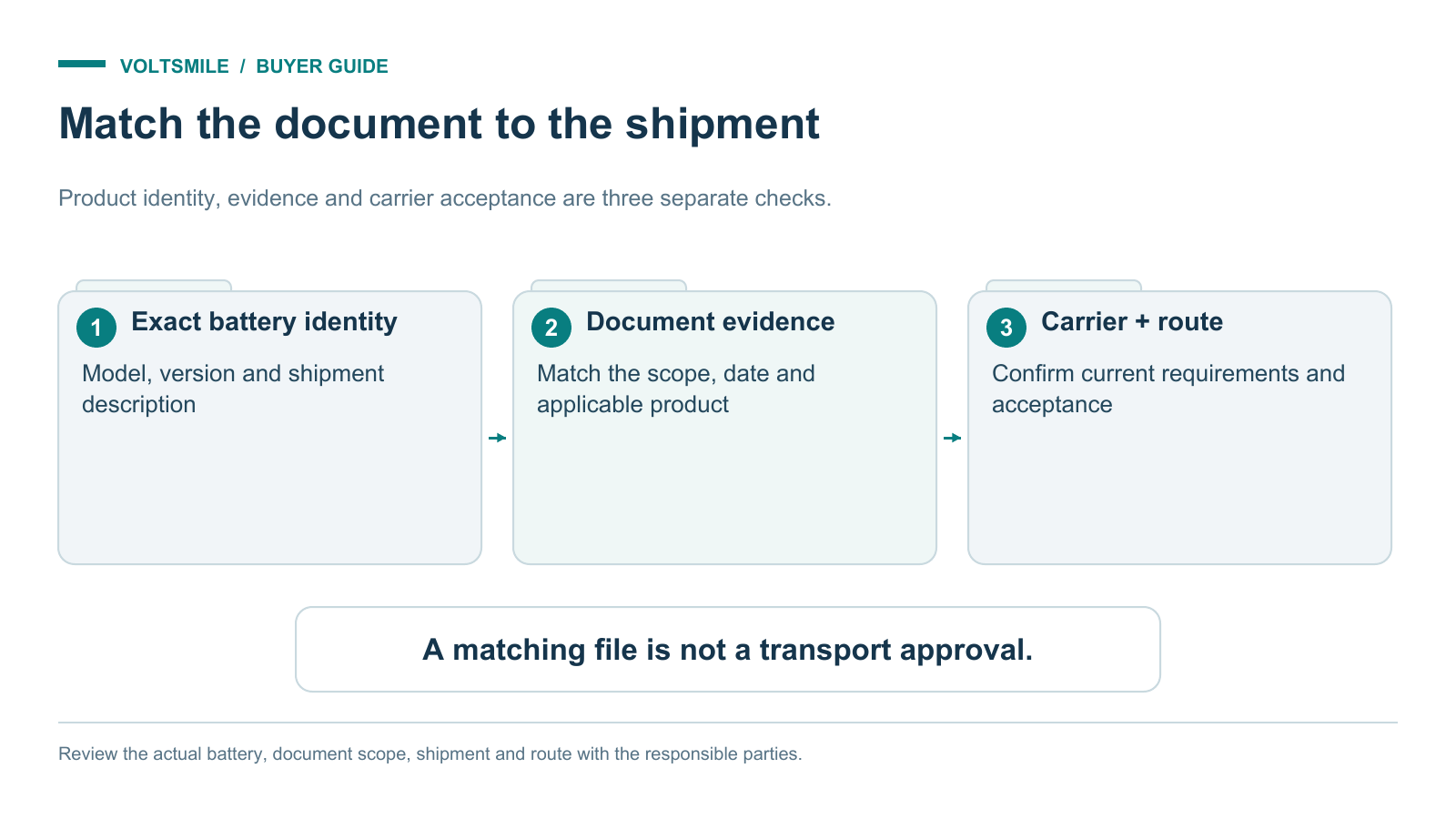
Use the model and version on the quotation, not a general product-family name. Confirm the manufacturer identity, battery description, quantity and proposed shipment arrangement. Ask the supplier how the documents correspond to the units it plans to supply.
If several battery models are included, keep their identities separate. Similar nominal energy or a shared enclosure appearance does not establish that one test document covers every model. A document for a cell is also not automatically evidence for an assembled battery.
For an RPC order, the V10 RPC product route identifies the intended model, not automatic document coverage. Ask for evidence applying to the offered version and actual shipment; neither a generic V10 filename nor a range listing proves that match.
Understand the purpose of a test summary
For air transport, IATA’s current battery guidance discusses the UN 38.3 test summary. Its purpose is to make identifiable test information available for the relevant battery type. It is not a blanket approval for any product carrying the same brand.
Ask for a legible document that identifies the manufacturer, testing organisation, report reference, battery description and the model coverage. Keep the document version or issue date with the quotation. If the supplied model designation differs, ask for an explanation of that relationship rather than assuming it is a harmless naming variation.
Do not turn the appearance of a UN 38.3 reference into the phrase “approved for every shipment.” Product evidence and the acceptance of a particular consignment have different scopes.
Give the freight provider the actual shipment information
The responsible provider needs to know the transport mode and route, the battery arrangement, quantity, packaging and relevant condition of the goods. Ask who will determine the applicable classification, packaging, marking and documentation requirements.
IATA explains that air carriers and states may apply additional restrictions. Air guidance should not be treated as a complete instruction for a sea or road shipment. The appropriate provider must review the rules and acceptance conditions relevant to the actual route and date.
If the model, packing arrangement or route changes after the initial enquiry, return the revised information for review. Do not assume a prior freight estimate or document check still applies unchanged.
Do not use one document to answer every question
A product datasheet, a safety data sheet, a test summary and an installation manual serve different purposes. A file showing chemistry or nominal energy does not, by itself, establish all transport requirements. Equally, a shipment document does not establish that the battery is suitable for a particular inverter or installation site.
Ask the supplier to identify what each supplied document covers and which questions need a freight-provider or technical response. Keep missing evidence visible. An empty field should not become “approved” simply because another file has been provided.
This is particularly important when buying a system containing multiple components. The battery, inverter and other goods should remain identifiable in the offer and shipment information rather than being reduced to a single informal description.
Connect the document review to the written offer
Keep the agreed product list, document references and delivery scope together. Identify who supplies the evidence, who reviews the consignment and who answers a mismatch. Ask for an updated response if the supplier proposes a different model or version.
Delivery charges and transport acceptance should also remain separate in the record. A quoted price is not proof that a carrier has accepted the exact battery shipment.
Il home-storage RFQ checklist covers the wider technical and purchasing enquiry. To discuss a Voltsmile order, include the destination, exact model, quantity and intended delivery arrangement, and request the product-specific documents for review by the responsible parties.
If the battery will carry your own brand, also review the manufacturer-brand or private-label purchasing route. Transport paperwork does not settle who holds the product responsibilities for that arrangement.
Questions buyers often ask
Is a test summary the same as shipment approval?
No. It provides defined product test information. The actual consignment and route still need the appropriate transport review.
Can one document cover multiple models?
It may, but the listed scope or supporting explanation must establish that coverage. Do not infer it from similar names or capacities.
Should an installer use shipping documents to confirm inverter compatibility?
No. Use the applicable product and integration instructions for that separate technical assessment.