


Comparing Home Battery Warranty Terms Before Choosing a Supplier
The number of years in a battery advertisement is only one part of a warranty comparison. Buyers also need to know which product is covered, when the period starts, what conditions apply, what remedy is offered and who handles the practical cost of a claim.
Before choosing a home battery supplier, request the written terms applicable to the exact model and intended market. Keep those terms with the quotation. A general website statement should not silently become a promise covering every product, region and installation.
Identify the product and the party making the promise
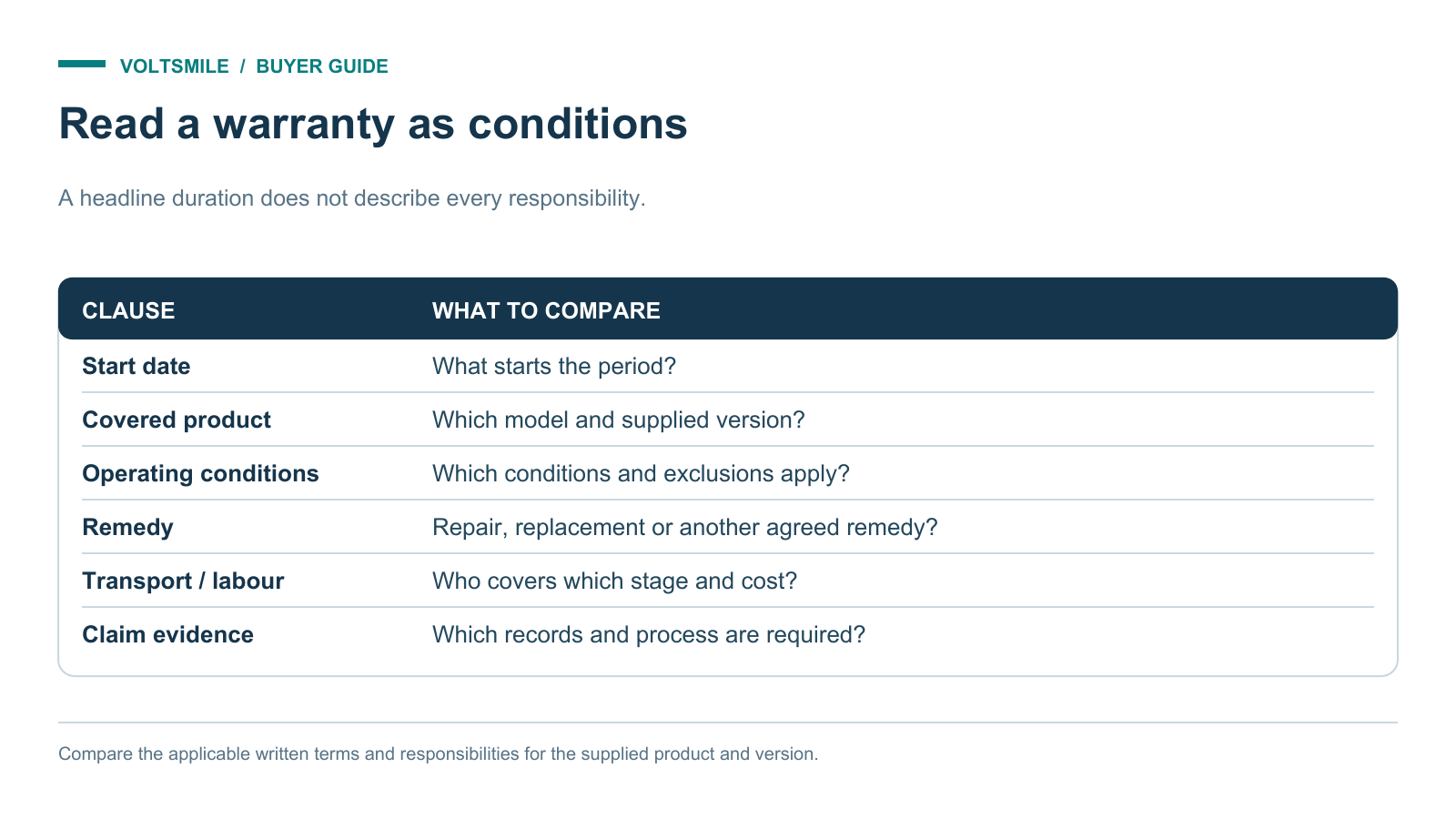
Check the model, supplied version, purchaser or end-user scope and geographical coverage. Ask which company provides the warranty and which seller or service contact receives a claim.
A system may contain products from several manufacturers. The battery warranty and the inverter warranty should remain identifiable rather than being merged into an assumed system-wide promise. An integration listing does not mean that one manufacturer has taken responsibility for every other component.
For example, Victron’s published limited-warranty policy defines conditions for its own products. Those terms must not be transferred to a connected Voltsmile battery. Request the battery’s applicable terms separately.
Check when the period starts
Ask for the event that starts the warranty clock and the evidence used to establish that date. The document may refer to manufacture, sale, delivery or another defined point. Do not substitute the installation date unless the applicable terms say it is the relevant event.
For a distributor, clarify how time in stock affects the downstream offer. For an installer, check which documents the customer will need to retain. A headline duration can be misleading if the buyer and seller are counting from different events.
Keep any extension or registration arrangement separate. Ask whether it applies to the exact product and transaction, what actions are required and who is responsible for completing them. Do not assume an advertised extension is already included.
Separate warranty from design-life and cycle statements
A design-life description explains a product expectation under its stated basis. A cycle-life figure belongs with the test conditions used to produce it. Neither is a substitute for the written warranty obligations.
When reviewing a datasheet, ask what conditions accompany any life claim. Then read the warranty separately for its coverage and exclusions. Do not turn a large cycle count into a guarantee that a battery will deliver a particular result in every household.
The general V10 product entry identifies one product route for requesting its applicable written terms. Keep the exact supplied revision and destination in the request. Do not transfer a V10 term to W1 or to every battery shown in the selection FAQ.
Read operating conditions and exclusions together
Check the installation and operating requirements referenced by the warranty. Ask how the applicable product documents, commissioning records and operating history will be used if a claim arises.
Have the installer identify responsibilities that belong to the complete system design. Do not assume that a battery warranty approves an unsuitable environment, a changed configuration or an unsupported combination with other equipment.
If a condition is unclear, ask for a written explanation before relying on it in an offer to an end customer. Keep the question narrow: identify the clause, the proposed use and the exact product. This is more useful than asking whether a battery has a “good warranty.”
Compare the remedy and practical responsibilities
Ask what happens when a covered problem is accepted: repair, replacement or another remedy specified by the terms. Clarify the process for reporting the issue and the evidence required for review.
Read the responsibilities for inspection, removal, packaging, transport, reinstallation and commissioning. These activities are not necessarily covered by the same party. A statement about repairing a product does not answer every question about the work needed at the property.
Keep initial delivery damage, a return for assessment and shipment after repair as separate stages when asking about transport responsibility. If a written answer does not identify the stage, seek clarification rather than applying it to all three.
Make the comparison part of the procurement decision
Use a short side-by-side comparison of coverage, start date, conditions, remedy, practical costs and claim contact. Leave unresolved points visible and request the missing document or clarification.
The home-storage RFQ checklist helps connect these questions to the wider equipment and supply scope. Hubungi Voltsmile with the destination, exact model and quotation reference to request the applicable terms before making a purchasing decision.
For a separately purchased battery, record the local-installation and support responsibilities alongside the warranty. Product cover does not appoint someone to visit the property.
Questions buyers often ask
Does a longer advertised warranty always provide broader cover?
No. Compare the covered product, conditions, remedy and practical responsibilities as well as the duration.
Does a cycle-life statement replace the warranty document?
No. They describe different things. Keep the test basis with the cycle claim and read the applicable warranty obligations separately.
Can I rely on another manufacturer’s warranty because the products work together?
No. Identify the separate promises and responsibilities for the battery, inverter and the installation services in the actual proposal.