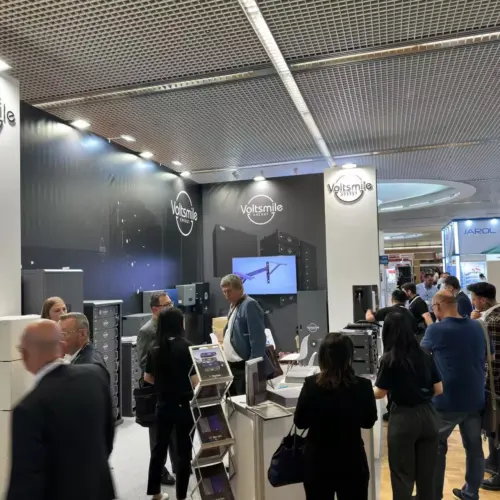


Outdoor Battery Storage System Manufacturing: How Voltsmile Delivers Reliable Energy Storage for Harsh Environments
The global shift toward renewable energy creates unprecedented demand for outdoor energy storage. Decentralized power grids need systems that operate reliably outdoors. These systems must withstand extreme temperatures, humidity, dust, and corrosive conditions. They must also deliver consistent performance over thousands of cycles.
Voltsmile leads this industry as a specialized outdoor battery storage manufacturer. The company combines advanced lithium iron phosphate (LiFePO4) chemistry with rugged engineering. Moreover, it integrates intelligent energy management into every product. This article examines outdoor battery storage manufacturing challenges. It also explains how Voltsmile addresses those challenges. Finally, it outlines what buyers should consider when selecting a manufacturing partner.

Why Outdoor Battery Storage Manufacturing Is Different
Outdoor deployment imposes stresses that indoor products never encounter. UV radiation, temperature swings, driving rain, and salt spray accelerate material degradation. Dust ingress compounds these problems further. Consequently, battery safety can suffer when enclosures and thermal systems lack proper engineering.
Beyond environmental durability, outdoor systems must also address several critical factors:
Thermal management under variable loads. Outdoor cabinets absorb passive heat from solar radiation during the day. They cool rapidly at night. Without active regulation, cell temperatures vary significantly across a battery rack. This variance reduces capacity and accelerates degradation.
Safety in unattended locations. Outdoor systems often operate in remote locations with limited oversight. Therefore, fire suppression becomes critical rather than optional. Thermal runaway prevention and remote diagnostics are equally essential.
Long service life with minimal maintenance. Accessing outdoor sites for maintenance is expensive. Therefore, the system must deliver reliability over 10+ years. Remote firmware updates and self-diagnostic capabilities support this goal.
Voltsmile’s Manufacturing Approach
LiFePO4 Chemistry for Safety and Longevity
Voltsmile builds all outdoor storage systems around LiFePO4 cells. This chemistry offers distinct advantages for outdoor applications. LiFePO4 remains inherently more thermally stable than conventional lithium-ion chemistries. As a result, thermal runaway risk drops significantly under abusive conditions. Voltsmile’s systems deliver over 6,000 deep cycles at 80% depth of discharge. This translates to more than a decade of reliable service in typical cycling applications.
Furthermore, the cobalt-free composition minimizes supply chain exposure and environmental impact. This aligns with sustainability objectives across many commercial and utility-scale projects.
IP65-Rated Enclosure Engineering
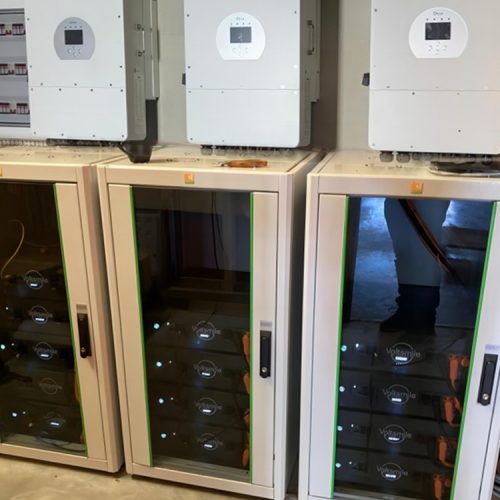
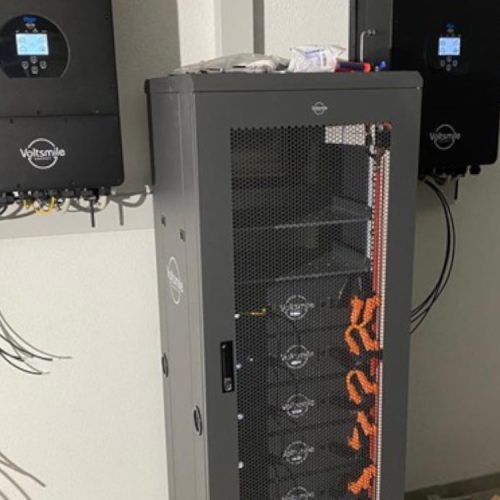
Every Voltsmile outdoor energy storage cabinet features an IP65-rated enclosure. This rating keeps the unit dust-tight and protected against low-pressure water jets. Consequently, reliable operation continues in coastal, desert, and arctic environments. The manufacturing process behind these enclosures involves precision sheet metal forming and gasket-ready door flanges. Structural welding ensures weather sealing remains effective over years of thermal cycling.
Voltsmile’s systems operate across a temperature range of -30°C to 60°C. This range covers both charging and discharging. As a result, deployment remains suitable in nearly any climate zone.
Intelligent Battery and Energy Management
Outdoor storage systems require sophisticated management to operate safely without constant supervision. Voltsmile’s Battery Management System (BMS) provides 24/7 cell balancing and over-voltage protection. It also prevents short circuits. The AI-driven Energy Management System (EMS) enables remote diagnostics and over-the-air firmware updates. Additionally, it performs intelligent load balancing to optimize energy arbitrage.
For projects involving multiple units, these management capabilities reduce site visits. They also enable proactive maintenance before failures occur. Integration with existing power infrastructure becomes simpler as well.
Modular Architecture for Scalability
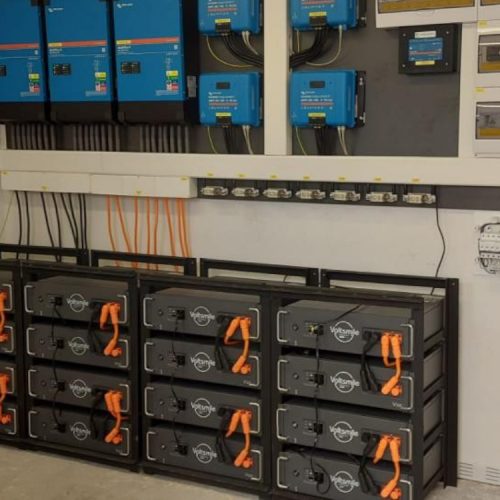
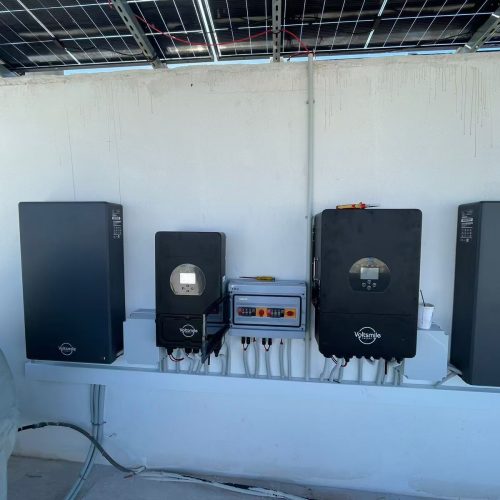
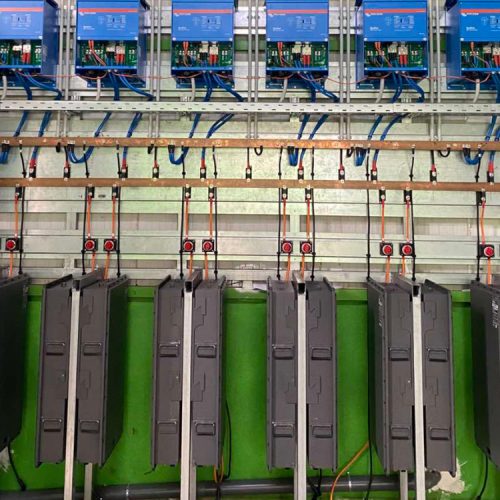
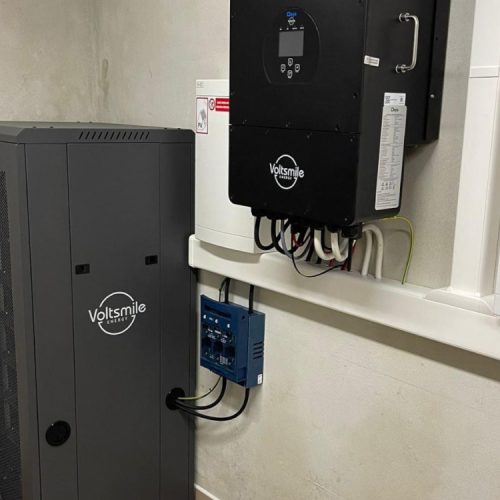
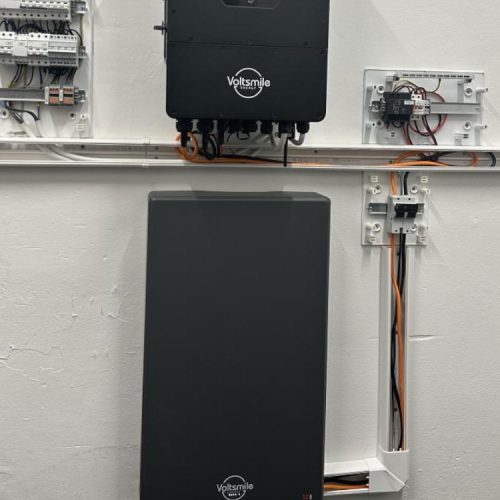
Voltsmile’s manufacturing approach emphasizes modularity. The all-in-one cabinet design integrates battery racks, BMS, HVAC, and hybrid inverter. This pre-assembled unit can expand from 5kWh to over 500kWh. Project requirements determine the final configuration. This architecture supports diverse voltage configurations including 48V, 96V, 120V, and high-voltage DC bus systems.
Furthermore, the modular design simplifies logistics and installation. Pre-tested cabinets can ship directly to project sites. They can also be commissioned quickly. Consequently, on-site labor costs and project timelines both decrease.
Applications Driving Outdoor Storage Demand
The market for outdoor battery storage systems continues to expand across multiple sectors. Global modular outdoor battery ESS markets are projected to grow. Renewable integration and grid resilience have become policy priorities.
Telecom and 5G infrastructure. Remote cell towers traditionally relied on diesel generators for backup power. Outdoor battery systems provide cleaner, more reliable backup. They also reduce operational costs.
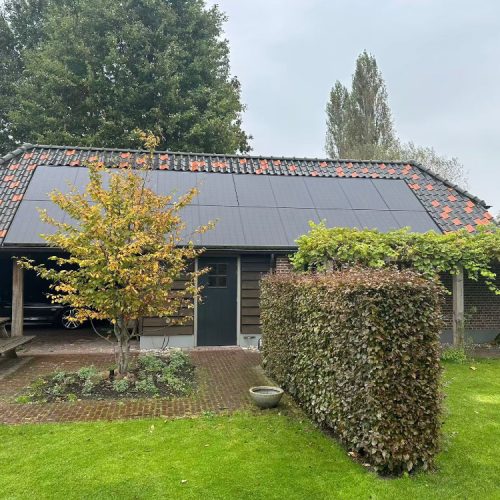
Renewable energy integration. Solar farms and commercial rooftop installations require storage to manage intermittency. They also need storage to maximize self-consumption. Outdoor cabinets can be sited near generation assets. Climate-controlled buildings become unnecessary.
EV charging support. Ultra-fast DC charging stations place significant strain on local grids. Outdoor battery storage provides peak shaving. This reduces demand charges and enables charging infrastructure in locations with limited grid capacity.
Industrial microgrids. Factories, data centers, and critical facilities deploy outdoor storage for island-mode operation. They also use it for demand charge management during grid outages.
Choosing an Outdoor Battery Storage Manufacturer
When evaluating manufacturing partners for outdoor storage projects, several factors distinguish capable suppliers from less suitable ones.
Verified certifications. Look for UL1973, IEC62619, CE, and UN38.3 certifications. These confirm the system has passed independent safety and performance testing. Certifications should cover the complete system, not just individual cells.
Documented thermal performance. Request thermal test data showing cell temperature uniformity. These tests should use representative load profiles. Temperature variance across a rack directly impacts cycle life and warranty exposure.
Customization capability. Projects rarely fit standard specifications. The manufacturer should offer configurable capacity, voltage, and communication protocols. RS485, CAN, Wi-Fi, and 4G/5G options all matter. Enclosure options should match site-specific requirements too.
Service and support infrastructure. Outdoor systems require long-term support. Confirm the manufacturer’s remote diagnostics capabilities and spare parts availability. Regional service network coverage matters before committing to large deployments.
Závěr
Outdoor battery storage manufacturing demands more than assembling cells into an enclosure. It requires thermal engineering, weatherproofing, and safety system integration. Intelligent management software must work together as a cohesive system. Voltsmile’s approach combines LiFePO4 chemistry, IP65 enclosure engineering, and modular architecture. Consequently, the company delivers outdoor storage solutions suited for telecom, renewable integration, EV charging, and industrial applications.
For businesses evaluating outdoor energy storage options, the manufacturing partner matters as much as the product specifications. A partner with proven engineering discipline reduces project risk. Transparent documentation and global support capabilities protect long-term returns too.